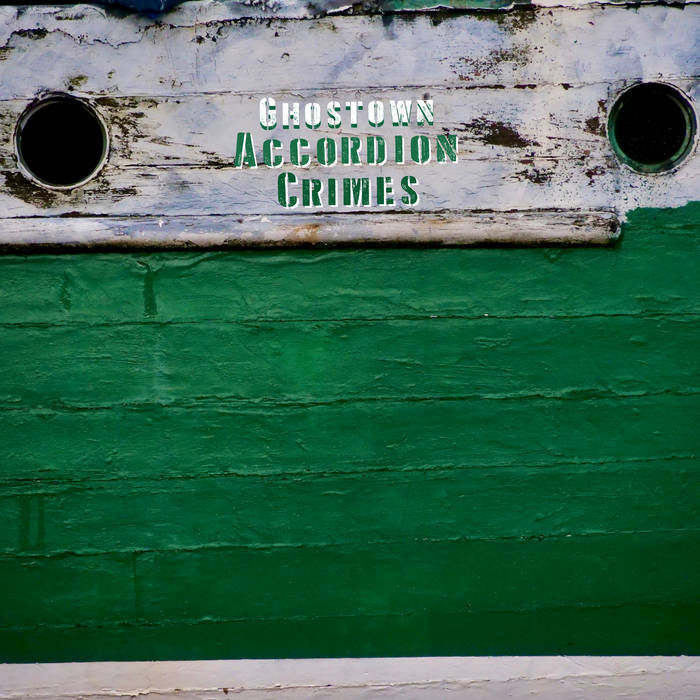
(2023) — Ghostown
Folk recordings transformed into experimental hip-hop, fictional crimes, coastal folklore and intricate verbal play.
Released: 29 September 2023
Artist: Ghostown
Production: Ghostown
Featuring recordings by: Jo Powell (accordion) and Cliff Charles (guitar)
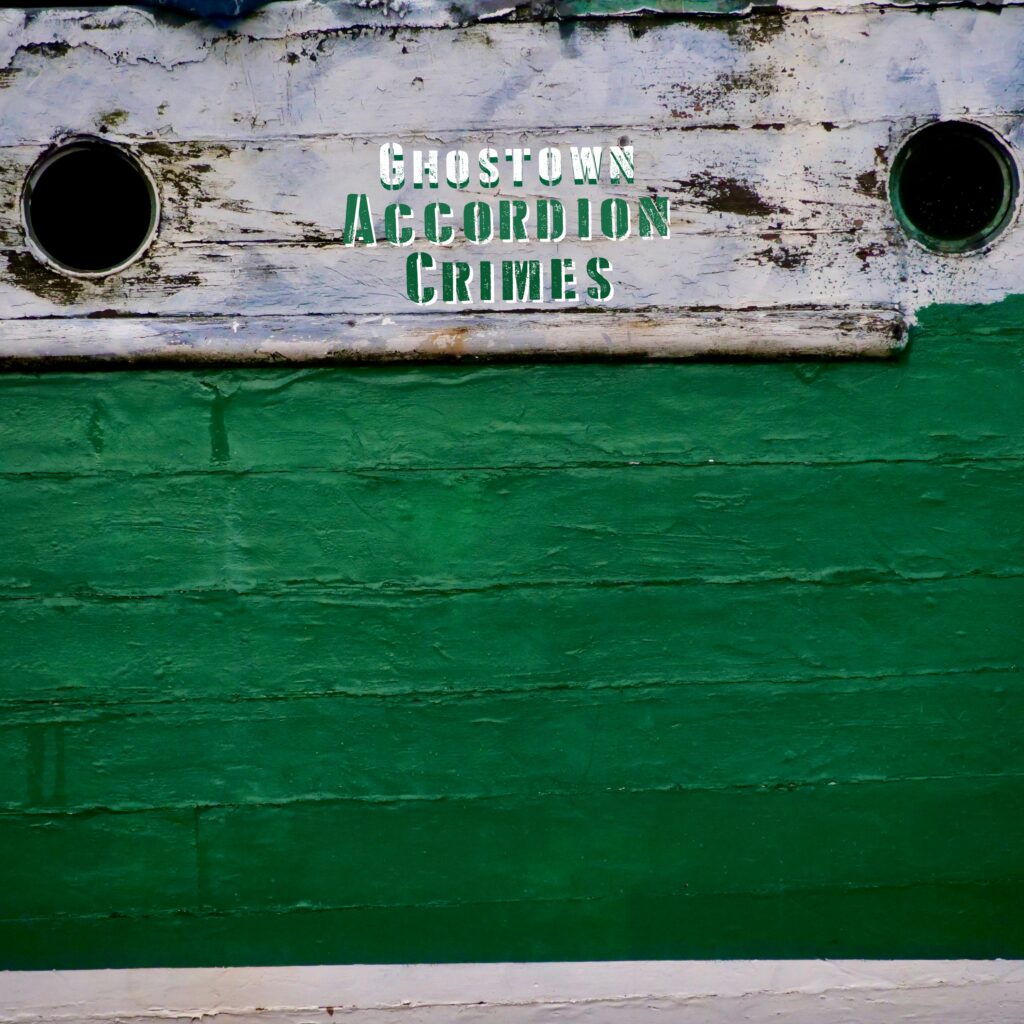
Cover photography: Ghostown
- 1 04:16
- 2 03:10
- 3 03:01
- 4 02:52
- 5 03:17
- 6 02:52
- 7 02:32
- 8 01:40
- 9 03:18
- 10 01:53
- 11 03:29
- 12 02:42
- 13 03:03
- 14 02:16
- 15 01:21
An Accordion in Unexpected Territory
The accordion is hardly the first instrument that comes to mind when discussing experimental hip-hop. Its associations with folk traditions, village dances and travelling musicians might seem far removed from drum machines, samplers and intricate rap vocals.
For Ghostown, however, that apparent incompatibility became the starting point for an unusually inventive album.
Accordion Crimes, released in September 2023, grew out of recordings made during an extended stay at his mother’s home in Sunderland Point, a small coastal village in Lancashire, England.
His mother, Jo Powell, is an accordion player whose repertoire includes traditional Eastern European music and original compositions. During 2022, Ghostown recorded her performances with the intention of transforming them into something entirely different.
The resulting album is not an exercise in simply adding hip-hop beats to folk melodies. Instead, the accordion becomes a source of musical raw material: melodies are chopped, rearranged, manipulated and sometimes transformed beyond recognition.
Around these recordings, Ghostown constructs original basslines, keyboards, synthesizer arrangements, programmed percussion and vocals, handling the production, mixing and mastering himself.
The project also extends beyond its initial concept. Guitar recordings by Cliff Charles, an old Busilacchio organ, traditional Greek folk samples and sounds inspired by classic video games all find their way into the finished record.
What emerges is an album that refuses to remain within a single musical tradition.
Sunderland Point: The Place Behind the Music
Sunderland Point is more than a recording location. Its coastal landscape, isolated atmosphere and small community provide an important backdrop to the album’s imagination.
The cover artwork is a photograph taken by Ghostown of a boat at Sunderland Point, giving the record a direct visual connection to its origins.
The village’s atmosphere also finds its way into the songwriting. The Row imagines the sinister possibilities hidden beneath the everyday familiarity of village life, while the maritime imagery of Hail Em In reflects the coastal surroundings and local traditions of sea-shanty singing.
Elsewhere, the album’s fascination with wandering musicians, outsiders and unusual characters connects naturally with the accordion’s cultural history.
The title Accordion Crimes is a playful reference to E. Annie Proulx’s novel of the same name, whose stories follow an accordion through generations of migration, hardship and violence.
Three compositions — Busilacchio, Stonybank Murders and Feather Weight — draw inspiration from the novel’s fictional world.
Yet the album never becomes a literal musical adaptation. The literary influence is one ingredient in a broader mixture of crime fiction, satire, personal observation, cultural references and rhythmic experimentation.

Sampling as Composition
One of the record’s most interesting qualities is the variety of approaches taken to its source material.
On some tracks, Jo Powell’s accordion remains recognisable, providing a melodic connection to the folk traditions from which it originates.
Elsewhere, the original recordings are manipulated so extensively that their source becomes difficult to identify.
Dance of Delight and Stonybank Murders are particularly revealing examples of this approach. The accordion is not simply preserved or accompanied; it is reconstructed into a different musical identity.
Other tracks dispense with the instrument altogether. Busilacchio uses an old organ played by Ghostown, Bipolar Bearsand Ah One Two incorporate guitar recordings by Cliff Charles, and Anyhow draws on traditional Greek folk music.
This diversity might suggest a collection of unrelated experiments, but the record maintains a recognisable personality through its rhythmic approach, unusual subject matter and distinctive vocal writing.
Ghostown’s lyrics are frequently dense with internal rhymes, multisyllabic patterns, alliteration and unexpected associations. At times, the words carry elaborate fictional narratives. Elsewhere, their principal function is musical, with language treated as another rhythmic instrument.
The album is therefore as much an exploration of the possibilities of vocal rhythm as it is a study in sampling.

Track-by-track review
01. The Row — 4:16
Opening with a composition built around Jo Powell’s accordion, The Row introduces the album’s fascination with eccentric characters and the darker possibilities of ordinary life.
Inspired by Sunderland Point, the song imagines a close-knit community in which everybody appears to know everybody else’s business. A succession of inhabitants emerges through deliberately exaggerated portraits: Jake hoards wood despite having no stove, Ron behaves mysteriously around his rubbish, and other neighbours display their own peculiar habits and obsessions.
The humour becomes increasingly uncomfortable as the narrator’s interest in these characters begins to resemble surveillance. The refrain presents the village as a place where everyone knows everything about everyone else. What initially sounds like an expression of community gradually acquires a more threatening meaning.
So welcome to the row
Where everybody knows?
Everything there is to know
We’ll watch you as you go
The last line changes the apparent warmth of the welcome into a warning. The question mark after ‘knows’ makes the narrator's certainty seem especially dubious: perhaps the greatest danger here is the observer himself.
The song’s strength lies in this ambiguity. The neighbours may be hiding secrets, but the narrator’s suspicions reveal just as much about his own imagination. Musically, the accordion provides an unusual foundation for a piece of satirical storytelling, while Ghostown’s basslines, keyboards and programmed rhythms move the material into his own distinctive territory.
The Row establishes the album’s tone immediately: playful, rhythmically inventive and just a little sinister.
02. Time of the Gypsies — 3:10
Named after Emir Kusturica’s 1988 film, Time of the Gypsies draws on an original accordion melody composed and performed by Jo Powell.
The title also carries a personal connection. Ghostown’s family history includes nineteenth-century circus performers, while his mother has a longstanding interest in Romani musical culture. The lyrics explore travel, memory, ancestry and the romantic possibilities of an itinerant existence.
One of the song’s defining features is its extended multisyllabic rhyming, with words and phrases linked through rapidly changing internal patterns. Rather than unfolding as a strictly chronological family history, the writing creates an impressionistic sequence of recollections and imagined experiences.
I grew with the best of them, remember the yester when
Life was a jester then, I was obsessed with them
Family blessed with them, gods do pester them
Out on a quest with them, memories a chest of them
The recurring ‘-ester’ sound carries the passage forward while the images move between remembrance and invention. The rhyme pattern behaves almost like an instrumental ostinato.
The accordion’s melodic character is especially important here. Unlike tracks that radically reconstruct their source recordings, Time of the Gypsies retains a direct connection to Jo Powell’s own composition.
The result is one of the album’s clearest expressions of its family origins, bringing together musical inheritance, personal associations and contemporary hip-hop production.
03. Dance of Delight — 3:01
Dance of Delight takes a traditional accordion tune performed by Jo Powell and subjects it to extensive manipulation. The resulting music is so far removed from the original performance that the traditional source is no longer immediately recognisable.
Against this reconstructed instrumental, Ghostown delivers some of the album’s most densely packed vocal writing. The lyrics move through rapid chains of multisyllabic rhymes, internal repetitions and deliberately unexpected word combinations.
At times, the sheer quantity of syllables becomes part of the joke, with the writing drawing attention to its own verbal excess. Yet beneath the linguistic acrobatics are references to social inequality, media manipulation and the concentration of wealth.
Mark indelible brand unsellable
Tank unfillable Hank formidable
Hank unkillable cut umbilical
Who's is billable? Too many syllables
The punchline openly acknowledges the density of the verse. This is not complexity for solemn effect: its excess is part of the comedy, and the vocal rhythm is as important as the semantic meaning.
The contrast between the intricate verses and the comparatively direct refrain provides an important structural balance. Dance of Delight demonstrates how the album’s two principal experiments — radical sample manipulation and complex rhythmic lyricism — can reinforce one another.
It is a composition driven as much by the physical sound of language as by the meanings of individual words.
04. Bipolar Bears — 2:52
Built around guitar recordings by Cliff Charles rather than accordion, Bipolar Bears introduces a lighter, jazz-influenced swing to the album.
Its central idea is theatrical: Ghostown performs two contrasting characters, adopting different vocal personalities and making subtle musical changes to accompany their opposing outlooks. One character is relentlessly optimistic, celebrating happiness, confidence, productivity and conventional success.
The other sees exploitation, financial pressure, religious hypocrisy and the frustrations of everyday existence. The humour comes from the exaggerated certainty of both positions.
Oh so happy!
Feeling looking so snappy
Smelling rose looking at me
My foes can't trap me
Bills do defeat us
So I’m turning down the heaters
As they beat us into Jesus
And the priests do deceive us
The switch from carefree self-assurance to material anxiety is immediate. Both voices are exaggerated enough to make the argument comic rather than didactic; neither receives the final word.
Neither character necessarily possesses the complete truth. Instead, the song exposes the absurdity of interpreting the world through a single emotional perspective. The title plays on these opposing temperaments rather than presenting a clinical portrait of bipolar disorder.
Musically, the shifting vocal performances are essential to the composition. Ghostown effectively stages an argument between two versions of reality, allowing rhythm, tone and characterisation to carry the comedy. It is one of the album’s clearest examples of vocal performance as dramatic storytelling.
05. Busilacchio — 3:17
One of the album’s more unusual production decisions occurs on Busilacchio. Despite its accordion-related narrative, the track contains no accordion samples. Instead, Ghostown plays an old Busilacchio organ found at his mother’s home, incorporating the instrument into his own keyboard-based arrangement.
The lyrics draw inspiration from E. Annie Proulx’s Accordion Crimes, following Johnny, an accordion player whose musical life becomes entangled with money, violence and imprisonment.
The opening establishes the central character through a clever double meaning: Johnny presses buttons both literally, as an accordionist, and metaphorically, through his provocative behaviour. As the story develops, the instrument becomes connected to ambition, possessions and criminal activity.
Busy button pressing
The box was a blessing
Playing on his buttons
Never been so refreshing
They’re never ever guessing
He never was confessing
The ‘button pressing’ image doubles as instrumental description and character sketch. The persistent ‘-essing’ rhymes give Johnny's increasingly questionable actions an almost cheerful momentum.
The narrative’s darker details contrast with the playful rhythmic construction of the lyrics. Long sequences of closely related rhymes create a sense of forward movement, while the repeated references to buttons, bellows and reeds keep the accordion present in the imagination even though it is absent from the recording.
This contradiction is one of the song’s most interesting qualities. Busilacchio demonstrates that the album’s concept is not limited to the physical sound of an accordion. The instrument also functions as a literary symbol, a source of characters and a gateway into strange fictional worlds.
06. Tempted — 2:52
Tempted turns away from fictional crime towards the pressures of modern consumer culture. The lyrics examine the constant encouragement to buy, upgrade, replace and discard.
Phones, fashionable products, shopping baskets and advertising become symbols of an economy that depends on perpetual dissatisfaction. Ghostown’s writing is particularly effective when describing the contradictions of consumer behaviour: the excitement of acquiring something new, the fleeting satisfaction of ownership and the financial consequences that follow.
The song also criticises planned obsolescence and the manipulation of consumer expectations through marketing. Its most memorable passages use densely connected rhymes to create the impression of thoughts racing from one purchase to another.
If it aint broke don’t fix don’t change it up
It don’t do what it says they made it up
Paid a few mill just to push those ratings up
You don’t need that just keep saving up
The conversational phrasing makes the critique feel practical rather than abstract. Its recurring end sounds drive home the song's insistence that the latest product is not necessarily an improvement.
There is an interesting relationship between the subject matter and the production philosophy of Accordion Crimes. Where the lyrics question a culture of constant replacement, the album itself demonstrates the creative possibilities of reusing and transforming existing material. Old recordings become new compositions rather than disposable objects.
Tempted is one of the record’s more direct pieces of social commentary, combining an accessible subject with Ghostown’s characteristic verbal dexterity.
07. Hail Em In — 2:32
Built around a recording of Jo Powell performing a traditional klezmer melody, Hail Em In connects the album’s Eastern European musical influences with a distinctly maritime imagination.
The lyrics evoke ships, pursuit, uncertain loyalties and the dangerous possibilities of life at sea. The imagery also reflects the environment of Sunderland Point, where the coastline and local sea-shanty traditions helped inspire the song.
Rather than presenting a conventional historical sea shanty, Ghostown combines nautical vocabulary with his own rhythmic, rhyme-driven approach. The result brings together two traditions that might initially appear unrelated: the melodic character of klezmer music and the collective storytelling associated with songs of the sea.
The song’s short phrases and recurring sounds help create a sense of urgency and movement. Within the album, Hail Em In is another example of how traditional musical material can become the foundation for an entirely different imaginative setting.
08. Seagull Trawler — 1:40
At only one minute and forty seconds, Seagull Trawler is one of the album’s shortest pieces. Its title immediately recalls the coastal environment surrounding the recording sessions at Sunderland Point.
Placed after Hail Em In, it extends the maritime atmosphere that runs through this section of the record. The concise duration also provides a change of scale following the album’s more elaborate vocal and narrative compositions.
Rather than requiring every track to develop a complete fictional world, Accordion Crimes allows space for shorter musical ideas. In the context of the album’s sequencing, Seagull Trawler acts as a compact interlude before the darker storytelling of Stonybank Murders.
09. Stonybank Murders — 3:18
Another composition inspired by E. Annie Proulx’s Accordion Crimes, Stonybank Murders follows Johnny, an accordion player whose suspicions over missing money lead to a violent confrontation with Alfie.
The story develops through murder, professional ambition and eventual disillusionment. What makes the narrative interesting is that Johnny’s apparent success does not provide the satisfaction he expects. Recognition and musical achievement cannot erase the consequences of his earlier actions.
The production is equally adventurous. Ghostown constructs the instrumental from recordings of Jo Powell’s accordion, manipulating the material so extensively that the finished music bears little resemblance to the original performances.
Now he’s on the stage right at the top of his game
He thought it would be better but if feels just the same
Autograph need signing, everybody knows his name
Thinks about Alfie and he’s feeling kinda strange
The repeated ‘-ame’ sound circles around the emptiness of Johnny's success. Public acclaim does not silence the memory of Alfie; the story's moral unease is contained in that contrast.
The composition also features two contrasting stylistic variations, introducing substantial musical changes within the same track. These shifts complement the narrative’s movement between violence, ambition and collapse.
Lyrically, the song combines intricate rhyme patterns with a remarkably compressed fictional biography. The result is one of the album’s most ambitious examples of storytelling, using both musical contrast and verbal momentum to sustain its dark narrative.
10. Feather Weight — 1:53
Feather Weight condenses an entire crime scenario into a single verse lasting less than two minutes. Inspired by the atmosphere of espionage cinema and the world of Bond-style villains, the song follows an assassin through the preparation and execution of a killing.
The lyrics move rapidly between urban locations, concealed weapons, precise movements and attempts to evade detection. Rather than developing a conventional chorus-led structure, Ghostown relies on a continuous sequence of tightly connected rhymes.
Short, percussive phrases establish the opening momentum before longer multisyllabic patterns introduce greater complexity. The effect is cinematic, resembling a succession of quick camera shots.
Third floor position
Set up aiming with precision
Out of hand his condition
Slight of hand the magician
The sequence is strikingly economical: location, aim, consequence and misdirection in four tightly rhymed lines. The mechanical regularity of the endings suits the assassin's methodical work.
The narrative’s final reversal is particularly effective. Having successfully carried out his assignment and attempted to erase the evidence, the assassin appears to discover that he himself is being followed. The hunter may have become the hunted.
Built around samples of Jo Powell’s accordion playing, the composition demonstrates the album’s ability to transform a traditional instrument into the foundation for an entirely different fictional atmosphere. Feather Weight is a concise example of Ghostown’s talent for combining rhythmic precision with narrative economy.
11. LeChuck's Lament — 3:29
Inspired by the music and eccentric fictional world of the Monkey Island video games, LeChuck’s Lament abandons conventional storytelling in favour of rhythmic invention.
Named after the series’ ghost pirate villain, the track incorporates samples from the games alongside Ghostown’s original production. Unlike the album’s accordion-based compositions, it does not draw on Jo Powell’s recordings.
The lyrics are deliberately free-associative, linking pirates, animals, fictional characters, cultural references and absurd situations through extended rhyme patterns. Rambo, Gandalf and Django appear alongside nautical imagery and increasingly unlikely verbal combinations.
Le Chuck whisky tango
Lone range Rambo
Monkeys and mangoes
Strung up like a banjo
The progression is governed by phonetic possibility rather than narrative necessity. That freedom makes the voice feel like another sampled instrument.
There is no central narrative or intended message. Instead, the voice becomes an additional rhythmic instrument, with words selected for their sounds, stresses and relationships to the underlying music.
The recurring passages reinforce the composition’s playful momentum, while the references to Monkey Island provide a suitably eccentric setting. LeChuck’s Lament illustrates an important aspect of Ghostown’s songwriting: complex lyricism need not always serve a serious argument or carefully developed story. Sometimes the pleasure lies in the unexpected combinations of language itself.
12. Anyhow — 2:42
Anyhow is something of an outsider within Accordion Crimes. Built around samples of traditional Greek folk music, it contains no accordion recordings and was conceived almost as a bonus track.
Nevertheless, its musical curiosity and energetic vocal writing connect it naturally with the rest of the album. The recurring refrain revolves around the idea of continuing forward despite uncertainty, combining the practical necessity of earning a living with playful, almost nonsensical phrasing.
The verses move through dense rhyme chains, everyday frustrations, cultural references and expressions of independence. References to contemporary technology, vinyl records and biblical characters appear within the same rapidly shifting lyrical landscape.
Launch like a catapult
Riot like a radical
Maniac fanatical
Seven year sabbatical
The four-line run demonstrates the way related consonants and vowel shapes can make apparently disconnected images cohere as rhythm.
Rather than constructing a single narrative, the song accumulates ideas through rhythmic momentum. The traditional Greek source material also broadens the album’s geographical imagination, demonstrating that Ghostown’s interest in folk music extends beyond the accordion and Eastern European traditions.
Anyhow may sit slightly outside the record’s original concept, but its inclusion reinforces the album’s refusal to be defined by one instrument or genre.
13. Ah One Two — 3:03
With Ah One Two, the album moves into noticeably different musical territory. Built around guitar recordings by Cliff Charles, the composition draws on trip-hop and electronica rather than the folk-influenced hip-hop that characterises much of the record.
The lyrical approach changes just as dramatically. Instead of dense verses or elaborate fictional narratives, Ghostown uses a series of short phrases repeatedly connected by the words ‘I want to’. The result is almost mantra-like.
Images of freedom, changing seasons, waves, healing and personal contentment create a mood of aspiration and release. Yet the repeated expression of desire introduces a subtle ambiguity. These experiences may represent possibilities being pursued rather than a state already achieved.
Feeling the freedom
I want to
Feel every season
I want to
Have enough reason
I want to
Here repetition does the work that internal rhyme does on earlier tracks. The simplicity is not a retreat from technique but a different use of it.
The comparatively restrained vocal writing allows repetition and atmosphere to become central features of the composition. Ah One Two is one of the album’s clearest stylistic departures, demonstrating Ghostown’s willingness to move away from both his usual lyrical density and the accordion-based concept.
Its importance becomes even clearer when heard alongside the following track.
14. Auchendinny — 2:16
Auchendinny continues the atmospheric electronic direction introduced by Ah One Two, but returns to recordings of Jo Powell’s accordion. In doing so, it reconnects the album’s late electronic experiments with the family performances that originally inspired the project.
The lyrics are concise and repetitive, concentrating on determination, movement and a sense of emotional affirmation. The recurring declaration ‘I feel soul’ provides a simple centre for the composition.
Elsewhere, the writing introduces more intricate rhythmic patterns, with repeated phrases and closely connected rhymes creating a chant-like effect. After the album’s various criminal narratives, eccentric characters and satirical observations, the directness of the lyrics feels significant.
I know I’m moving forward
Yes I’m moving towards the goal
I feel soul
I feel soul
I feel soul
The repetition strips the language down to feeling. Its unguarded simplicity is particularly effective after so many densely plotted and densely rhymed tracks.
There is no elaborate fictional world to decode. Instead, the emphasis falls on movement, persistence and feeling. Although one more track follows, Auchendinny functions as the album’s principal musical conclusion.
Its combination of ambient electronica and accordion samples brings the project back to its beginnings without abandoning the stylistic territory explored along the way.
15. The End For You — 1:21
The album concludes with a short instrumental epilogue built around guitar samples recorded by Cliff Charles and vocal snippets of pirate insults from Monkey Island 2: LeChuck’s Revenge.
At just eighty-one seconds, Tis the End makes no attempt to deliver a grand finale. Instead, it returns to the eccentric humour of LeChuck’s Lament, allowing the fictional pirates to make one last appearance.
Following the more reflective atmosphere of Auchendinny, the piece resembles an unexpected post-credits scene. Its playful character is entirely consistent with an album that has repeatedly balanced dark subject matter with absurd humour.
The absence of accordion is also characteristic of the record’s willingness to move beyond its original premise. After fifteen tracks of unusual samples, elaborate rhymes, fictional criminals and musical experimentation, Accordion Crimes ends not with a dramatic resolution but with a mischievous farewell.
Final assessment — more than an accordion album
The most compelling quality of Accordion Crimes is how thoroughly it refuses to stay inside its original premise. Jo Powell’s accordion is its creative and emotional starting point, but the album is equally interested in what happens when inherited sounds are cut apart, recontextualised or replaced by unexpected instruments.
That breadth brings some unevenness: the move from dark narrative hip-hop to game-inspired nonsense and ambient repetition will not suit listeners looking for a uniform mood. Yet the shifts also make the record recognisably personal. The crime stories are compact and inventive; the vocal writing frequently treats syllables as percussion; and the more restrained final tracks reveal a different side of the same producer.
Rooted in a family home on the Lancashire coast, Accordion Crimes ultimately makes a case not for the accordion as a hip-hop novelty, but for sampling as an act of composition and musical inheritance as something that can be reshaped without being forgotten.
Credits
Ghostown: composition, vocals, bass, keyboards, programming, sampling, production, mixing and mastering.
Jo Powell: accordion recordings and original accordion compositions used as source material.
Cliff Charles: guitar recordings used as source material on selected tracks.
Cover photograph: Ghostown, Sunderland Point, Lancashire.
Released: 29 September 2023.