
To the problem you didn’t know you had
An acoustic detour through digital alienation, social conformity, capitalism, freedom and the endless cycles of human existence
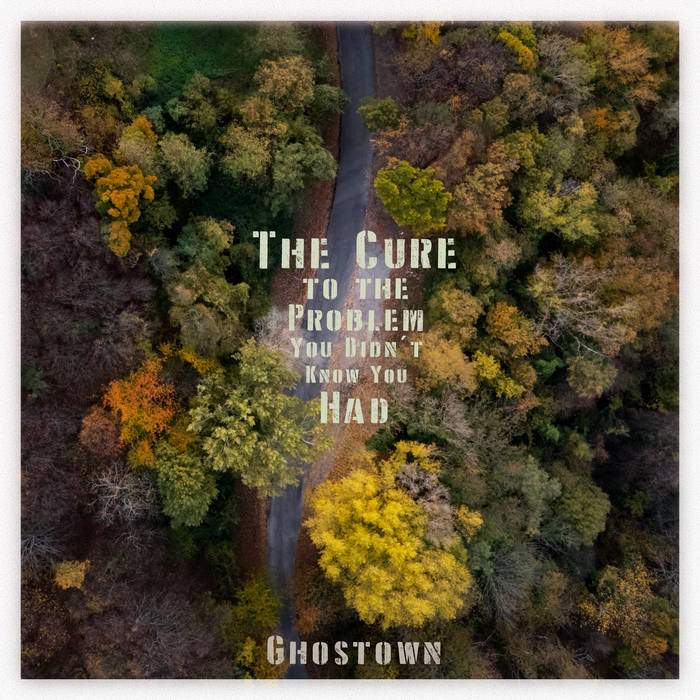
- 1 03:15
- 2 02:20
- 3 04:32
- 4 02:01
- 5 03:14
- 6 03:42
- 7 03:31
- 8 02:56
- 9 03:10
- 10 03:57
- 11 03:18
- 12 03:31
- 13 01:55
- 14 05:12
- 15 02:45
- 16 03:27
- 17 03:31
The Cure to the Problem You Didn’t Know You Had (2022)
An acoustic detour through digital alienation, social conformity, capitalism, freedom and the endless cycles of human existence.
Listen to the album on Bandcamp
An Unconventional Cure for Modern Life
Released on 9 September 2022, The Cure to the Problem You Didn’t Know You Had represents a departure from Ghostown’s established approach. Known for electronically constructed, bass-heavy alternative hip-hop, the independent artist turns towards acoustic guitar, unconventional rhythmic patterns and a more stripped-back musical framework.
Much of the album was conceived in 2021 against the backdrop of COVID-19 lockdowns. Isolation, political disagreement and digital dependence provided material for songs that question contemporary society. Yet the album’s concerns extend well beyond the pandemic, taking in migration, colonial power, labour, consumerism, environmental destruction, personal identity and the search for freedom.
The move towards acoustic instrumentation is significant. Ghostown initially considered abandoning drums altogether, exploring guitar arrangements that did not always follow conventional hip-hop structures. The contrast is striking: an increasingly organic musical approach accompanies lyrics about a world shaped by artificial environments and technological systems.
The title hints at an ironic promise: a cure for a problem that may not have been properly understood, or may even have been manufactured. Rather than presenting one manifesto, the fourteen principal tracks move between fictional narrative, personal reflection, satire, pessimism and moments of genuine optimism.
Track by Track
01. No Cookies — Childhood freedom in a digitally monitored world
The album opens with a double meaning: American cookies and the browser cookies that demand our consent. Ghostown contrasts the incessant permissions and invisible tracking of online life with memories of a childhood spent cycling, exploring forests and finding entertainment beyond screens. VHS tapes and house telephones evoke a world before digital connection became a constant condition of everyday life. The song does not need to prove that the past was objectively better; its point is that the texture of freedom has changed. Physical exploration and spontaneous play sit opposite a present in which even a simple website visit involves negotiations with unseen systems. Its humour makes the criticism accessible, while the autobiographical detail gives it warmth. As an opener, it establishes a recurring question: does technological convenience necessarily make us freer?
Want no cookies please no cookies
I’ve got biscuits in my jar
The memories are not presented as proof that the past was objectively better. Rather, they reveal how profoundly the everyday experience of childhood has changed within a relatively short period. In the earlier world, freedom is physical and immediate: children venture outdoors, invent their own activities and discover their surroundings without constant digital mediation.
The modern internet, by contrast, appears as a succession of interruptions, permissions and invisible observation. The persistent request to accept cookies becomes a symbol of the compromises involved in participating in digital society. There is an additional irony in a technology once associated with open communication becoming a mechanism for monitoring behaviour.
As an opening statement, the song introduces one of the album’s central questions: whether technological progress necessarily produces a greater sense of freedom. Its autobiographical warmth prevents the criticism from becoming abstract. Behind the joke lies an affection for experiences that cannot be reproduced through a screen.
02. Where’s Will? — Willpower, wordplay and the difficulty of acting
Will is not a missing person but the personification of willpower. Ghostown plays with a word that can be a name, an expression of determination and an auxiliary verb pointing towards the future. Questions about where, when and what Will will do turn motivation into a comic missing-person mystery. The song grew from a guitar riff, with its verbal puzzle taking shape around the musical idea. Under the joke lies a recognisable dilemma: knowing what needs doing is not the same as finding the resolve to do it. Its short form highlights the album’s fascination with language as sound as well as meaning.
Will Will throw
In the towel?
I think so
The multiple meanings of the word allow Ghostown to turn a common grammatical auxiliary into a character who is simultaneously present in nearly every question and somehow impossible to locate. The song’s apparent nonsense becomes a surprisingly precise way of depicting the difficulty of finding determination.
This is also a revealing example of the artist’s fascination with language as material. Words are chosen not simply for what they communicate but for the collisions between sound, syntax and meaning. The guitar riff that inspired the song becomes the framework for a verbal puzzle.
Beneath the humour is an ordinary human dilemma: understanding what needs to be done does not mean possessing the resolve to do it. Its brevity offers a lighter interval before the album turns to more difficult social subjects.
03. Nofra Jet — Migration, exploitation and belonging
A fictional traveller leaves a poor homeland hoping for opportunity in a wealthier country. The journey instead exposes him to exploitation by smugglers, hostility and detention. His eventual return home closes the narrative’s circle and complicates the assumption that material prosperity guarantees belonging. This is not a universal argument against migration; it is the story of one person’s expectations colliding with reality. Ghostown draws attention to the inequalities that motivate movement and the opportunists who profit from vulnerability. Home, in the end, means more than economic advantage: it also encompasses familiarity, identity and connection.
Worn feet soles, one soul, one goal
Bought and sold, let him roll, let him roll to the gold
The traveller’s hopes are understandable. Economic inequality encourages him to imagine that a richer destination will provide security and dignity unavailable at home. But the journey exposes the gap between a country’s imagined prosperity and the precarious reality of arriving there without protection or support.
The narrative also draws attention to the people willing to profit from desperation. Smugglers and exploitative intermediaries become part of an economy built upon unequal opportunities, while the reception awaiting the traveller challenges his expectations of welcome.
The circular ending is important. His return does not establish a universal lesson about whether people should migrate; it completes one fictional individual’s journey from longing to disillusionment and renewed appreciation. Material prosperity and emotional belonging are not interchangeable, and the meaning of home proves more complicated than an economic calculation.
04. Not@ Robot — Humanity in the age of verification
The absurdity of CAPTCHA prompts becomes a miniature satire of modern life: human beings must prove to machines that they are human. The @ sign in the title reinforces the online setting. Beyond the immediate joke lies a question about individuality in systems built around standardised procedures. Human beings are inconsistent, unpredictable and imperfect; those qualities can be inconvenient for automated services, but they are also part of being human. Together with No Cookies, the song considers the small submissions people make in exchange for access to the digital world.
I’m not a robot I’m a series of mistakes
I get pains, I get aches
I play for higher stakes
The joke is immediately recognisable: before accessing a service, a person must convince an automated system that they are not an automated system. The inversion of authority is absurd, even when the underlying technology has a practical purpose.
Ghostown extends this everyday irritation into a question about individuality. People are inconsistent, imperfect and unpredictable; those traits may frustrate standardised systems, but they are also integral to human experience. The song suggests that independent thought cannot be reduced to passing a prescribed test.
Placed alongside No Cookies, it reveals a recurring pattern: access to digital convenience depends on compliance with rules established by machines and platforms. The submission may be minor in any single instance, but its repetition gives it wider significance.
05. Vijion — Online identities and manufactured validation
Two portraits illuminate different kinds of digital dependency. A social-media influencer curates her appearance through filters, cosmetics, likes and sponsorships; a gaming influencer finds status and imagined authority in rankings and followers. Their worlds differ, but both rely upon external validation and an unstable gap between online representation and lived reality. The song’s satire is not simply an objection to entertainment or technology. It questions what happens when virtual rewards become a primary source of identity. Where earlier tracks examine what platforms demand of users, Vijion examines what users begin to demand of themselves.
Dopamine rush
Cheeky comment blush
Then all is quiet hush
Teary eyed gush
The first portrait revolves around the presentation of an idealised self. Filters, cosmetics, follower counts and sponsorships turn appearance into a performance whose rewards are measured publicly. The pursuit of likes offers a short-lived sense of recognition that must continually be renewed.
The second portrait transfers the same mechanism into online gaming. Rankings, followers and competitive victories create a convincing sense of authority within the virtual environment. Removing the headset, however, reveals the distance between that constructed status and everyday life.
The two characters are not identical, but their dependencies are parallel. One seeks approval through visibility, the other through virtual achievement. Both risk allowing external systems of reward to define their identity. The song is less an argument against particular pastimes than a criticism of the moment when representation begins to replace direct experience.
06. Lil Hobo — The restless outsider
Inspired in part by the television series The Littlest Hobo, the song follows a wandering outsider who moves from one situation to another. Sometimes leaving is a choice; sometimes insecure work and changing circumstances make it unavoidable. Ghostown draws upon his own experience of numerous jobs, school changes and repeated moves, without turning the song into a literal autobiography. The bilingual English and French writing adds another dimension. The French passages were influenced by the colloquial rhythms and disillusioned outlook of Louis-Ferdinand Céline’s Voyage au bout de la nuit. Wandering can represent independence and possibility, but also loneliness and the absence of security. The song leaves that tension unresolved.
Bouger sans cesse juste pour changer d’air
Des vieux chagrins, des nouvelles misères
Pourchassé, poursuivi, un bouc émissaire
The inspiration from The Littlest Hobo gives the wanderer an ambiguous appeal. Like the television dog’s recurring departures, moving on can suggest independence, curiosity and resistance to becoming trapped. But it can equally suggest loneliness and the absence of a secure place to belong.
Ghostown’s experiences of numerous occupations, repeated house moves and changing schools provide an autobiographical foundation without making the track a literal diary. Some departures arise from the choice to reject unsatisfactory circumstances; others reflect the economic insecurity that makes stability difficult to achieve.
The bilingual English and French passages deepen the outsider perspective. The influence of Louis-Ferdinand Céline’s Voyage au bout de la nuit can be felt in the interest in colloquial expression, disillusionment and the restless observer passing through different social worlds. The question beneath the wandering is whether freedom lies in finding somewhere to belong or retaining the ability to leave.
07. All Is His — Conquest and the endless appetite for ownership
A symbolic figure arrives, claims land, taxes people and sets them to work. The narrative invokes European colonial conquest in the Americas and Africa, then expands into deforestation, industrial labour, closed small businesses and manipulated belief. Its protagonist is not a single historical individual but an embodiment of the appetite to possess and dominate. The repeated claim that everything belongs to him becomes increasingly grotesque. Religion, entertainment, fear and economic power appear as tools through which control can be maintained. The song’s scope is intentionally allegorical: it links historical conquest to more contemporary patterns of accumulation. Its themes return in Serf, which examines the people living under such arrangements.
He trapped them in a wide web
And sent them all to sleep
Entertain their brain waves
And turned them into sheep
The central figure should not be read as one named historical individual. He is an allegorical embodiment of an appetite for possession that moves across periods and institutions. The conquest of land and people evokes European colonial expansion in the Americas and Africa, but the story extends beyond its historical starting point.
As the narrative advances, domination takes industrial and economic forms. Factories, the suppression of smaller businesses, the extraction of resources and the destruction of forests all follow the same principle: what exists must be converted into something that can be owned, controlled or exploited.
The inclusion of religion, entertainment and fear suggests that power is maintained through perception as well as material force. The protagonist’s claim to ownership becomes grotesque precisely because success never satisfies him. The song establishes the ruling mentality whose consequences are examined later from the perspective of workers in Serf.
08. Ghost Isle — Imagining another way to live
After the acquisitive world of All Is His, Ghost Isle imagines an alternative founded on cooperation, renewable energy and a more sustainable relationship with nature. It is a speculative space rather than a detailed political blueprint. The island represents the freedom to ask whether familiar hierarchies and economic arrangements are inevitable. Ghostown’s video uses imagery from the game Monkey Island, bringing a playful fictional landscape into contact with a serious desire for alternatives. Like Lil Hobo, the song explores escape; unlike the wanderer, its imagined community seeks a place where independence might endure.
I do dream of a place to be free
Far away from the hypocrisy
Green valleys and a bay by the sea
An island is a useful imaginative setting because it offers both separation and the possibility of beginning again. Ghostown uses that freedom to consider a community organised around cooperation, renewable energy, sustainability and less rigid hierarchy.
The proposal is not presented as a fully developed economic manifesto. Its purpose is to challenge the assumption that familiar arrangements are inevitable. The very act of imagining an alternative becomes a response to the acquisitive world of All Is His.
The video assembled from Monkey Island imagery adds a playful layer: a fictional game landscape becomes the visual language for thinking about a different reality. Like Lil Hobo, the song concerns escape, but here the ambition is not perpetual movement. It is the possibility of creating a place where greater independence might last.
09. Wake Up Woke — Satire, language and cultural conflict
One of the record’s most provocative songs, Wake Up Woke expresses Ghostown’s frustration with what he perceives as excessive political correctness, rigid ideological categories and constraints on speech and humour. The lyrics use deliberate exaggeration, from forms of address to public denunciation and absurd accusations. These are the artist’s satirical claims, not neutral descriptions of every social movement involved. A reference to hardship in a Glasgow slum questions the adequacy of broad labels that overlook economic circumstances. The repeated references to lobbying point chiefly towards corporate and political influence over public debate. The song is likely to divide listeners, but its place in the album is clear: it continues the investigation of conformity, power and who gets to define acceptable behaviour.
Can’t say this
Can’t say that
People hate
They don’t chat
The song’s deliberately exaggerated examples should be understood as expressions of the artist’s perspective rather than as neutral accounts of every social movement or changing convention it mentions. Its targets include what Ghostown perceives as ideological rigidity, public denunciation and a diminishing tolerance for irreverent humour.
A reference to economic hardship in a Glasgow slum complicates broad claims about social privilege by pointing towards class and material circumstances. The repeated references to lobbying principally concern corporate and political influence over public debate, linking cultural arguments with the album’s wider interest in concentrated power.
This is likely to be one of the record’s most divisive tracks. Some listeners may recognise a defence of open expression; others may question its assumptions or the targets of its satire. Within the album, its role is to extend the examination of who defines acceptable behaviour, and how conformity can be enforced socially as well as economically.
10. Spring Ahoy — A breath of fresh air
Spring Ahoy provides a bright contrast to the surrounding social criticism. Cycling, walking, hang-gliding, skiing, fishing and mountain landscapes become invitations to leave worries behind and reconnect with the outdoors. Its tumbling internal rhymes and playful images create an impression of continuous movement. The nautical Ahoy turns the new season into an adventure. Occasional references to wealth and social pressures remain, but the song’s purpose is celebration rather than argument. Where Ghost Isle imagines a different society, Spring Ahoy points to pleasures already available in the natural world. Its optimism is an important part of the album’s emotional range.
Bike riding tyres embolden
Hang gliding skies all golden
Ski sliding riding rolling
The song’s cascade of rhymes creates a sense of forward motion appropriate to the activities it celebrates. Cycling, walking, hang-gliding, skiing and fishing are presented as direct encounters with the world rather than performances designed for an online audience.
The title’s nautical greeting turns spring into an adventure. After the album’s anxious observations about systems, surveillance and social pressure, the natural environment offers something less mediated: fresh air, changing landscapes and the pleasure of physical movement.
Spring Ahoy is not detached from the rest of the record. It answers some of the earlier concerns without trying to solve them politically. Where Ghost Isle imagines an alternative community, this song points towards freedoms already available in ordinary experience. Its optimism is essential to the album’s emotional balance.
11. Leaning — Anxiety and the struggle to stay upright
The command to stand straight introduces a metaphor for psychological instability. Ordinary chores, mobile-phone dependence, insincere interactions, hidden information and financial pressure crowd the narrator’s mind. The repeated answer to everyday questions is simply that he is leaning: neither confidently upright nor completely collapsed. COVID lockdowns influenced the song, lending particular force to its images of confinement, pacing, distrust and uncertainty. Thin ice and deep water suggest precariousness, while references to copied-and-pasted culture and declining status widen the concern beyond the pandemic. Dense, cascading rhymes imitate an anxious stream of thought. Where All Is His describes structures of power, Leaning conveys the emotional experience of living amid them.
Stand up straight you’re leaning
Wondering what is the meaning
The instruction to stand straight establishes a metaphor for a narrator who has not completely collapsed but cannot regain his equilibrium. Everyday chores, mobile phones, insincere social encounters and the pressure to keep earning crowd into the same anxious mental space.
The song was influenced by the COVID-19 lockdowns, which give particular force to its images of confinement, pacing and uncertainty. Yet its worries extend beyond that period. Thin ice, deep water, mass imitation and the pursuit of an increasingly elusive financial security suggest a broader condition of modern instability.
The repeated answer to ordinary questions—’I’m leaning’—makes the refrain both comic and unsettling. Familiar exchanges fail to produce reassuring answers. Dense internal rhymes reinforce the impression of thoughts arriving faster than they can be resolved. Where All Is His describes power from above, Leaning registers its psychological consequences from within.
12. Serf — Labour, consumption and the illusion of choice
Serf imagines modern workers as economic dependants, using medieval bondage as a provocative metaphor rather than a literal historical equivalence. The song speaks in the collective voice of an imagined ruling class. Its speakers describe bulldozers, mining, exploited nature, contracts, costly housing and a workforce sustained by fear. Children are kept occupied by screens, while surveillance and compliance help maintain the arrangement. Most pointedly, workers are encouraged to earn and then consume: the apparent abundance of products disguises how little influence individuals may have over the conditions of their lives. Its shopping-trolley imagery distinguishes consumer choice from deeper autonomy. All Is His depicts the accumulation of power; Leaning depicts its psychological pressure; Serf depicts the cycle of work and spending that can perpetuate dependency.
Choices are abundant but redundant in this scheme
The song’s ruling-class voice is deliberately grotesque. Rather than hiding its motives, the imagined elite openly describes the removal of landscapes, extraction of resources and manipulation of workers. The medieval reference is metaphorical: the song questions modern economic dependence without claiming that contemporary employment is literally identical to historical serfdom.
Housing occupies a particularly important place in the critique. When a substantial share of wages is required simply to maintain a roof overhead, the threat of losing income can encourage compliance. Fear becomes an economic instrument, while consumption is presented as the reward for continuing to work.
The apparent abundance of products masks a narrower range of meaningful choices. People can select between commodities without controlling the structures that determine their labour, housing or access to resources. Images of children surrounded by screens and adults subject to monitoring connect the economic argument with the album’s earlier technological criticism.
Taken together, All Is His, Leaning and Serf form a revealing sequence. The first depicts the accumulation of authority, the second the anxiety of living amid its consequences, and the third the recurring cycle of earning and spending that may sustain dependence.
13. Have a Beer — A toast to forgetting your troubles
This brief, playful song answers every worry with the same advice: have a beer. Loneliness, criticism, confusion and fear all receive an identical remedy. The opening hangover makes the joke immediately circular: the proposed cure may be part of the problem. Short rhymes and relentless repetition make the suggestion increasingly absurd, yet the song also recognises a familiar desire to stop thinking about difficulties for a while. A shared toast can offer comfort even when it solves nothing. After Serf’s severity, the lightness is welcome. The track also gently echoes the album’s title by proposing an improbably simple cure for complicated problems.
Have a beer
Hungover full of fear
Don’t worry how to steer
Have a beer
The opening reference to a hangover makes the proposed remedy immediately self-contradictory: another drink is offered as the cure for a problem that drinking may have caused. As the song proceeds, different worries receive the same absurdly uncomplicated answer.
Its deliberately short phrases and repeated suggestion have an almost nursery-rhyme simplicity, especially after the verbal density of Leaning and Serf. The humour does not depend upon treating alcohol as a genuine universal solution. Instead, it recognises the temptation to set complicated worries aside temporarily.
A shared toast can provide a moment of comfort or companionship even if it changes nothing about the circumstances that prompted it. In this sense the song echoes the album title: modern life is full of promises that a single convenient remedy will address problems far too complex for such a response.
14. Seasons — The endless cycles of life
Seasons is the album’s true thematic ending. Its unusually persistent repetition is not incidental: it enacts the recurring patterns of waking, striving, arguing, separating, reconciling and starting over. A brief central passage turns to wind, branches and falling leaves, then to learning, yearning and growing older. Nature renews itself through cycles, but individual lives do not stand still. The same kinds of experiences return while the people living through them change. This gives the song its central paradox: repetition can be reassuring and exhausting, yet every recurrence carries us further through time. Seen from this perspective, the album’s digital habits, economic cycles, wanderings and searches for freedom become variations on a broader human pattern. Rather than resolving its many arguments, Seasons ends with the world continuing to turn.
So the wind advances
Silent rarely answers
Blowing through the branches
The fallen leaf dances
The song’s unusually persistent repetition is central to its meaning. Waking, striving, arguing, separating, reconciling and beginning again recur so insistently that the listener experiences something of the routine being described. The form enacts the subject.
The images of wind, branches and falling leaves connect human experience with the natural world’s cycles of growth, decline and renewal. Yet the analogy is imperfect in an illuminating way. Seasons return, but an individual life moves irreversibly forward; the fallen leaf does not return simply because another spring arrives.
The references to learning, yearning and growing older introduce this tension between recurrence and change. People revisit familiar situations, but the accumulated effects of memory, disappointment and experience alter who they are. Repetition may be comforting or exhausting, and often both at once.
As the thematic finale, Seasons draws the record’s diverse concerns into a wider perspective. Digital habits, economic routines, wanderings and repeated searches for freedom are all variations on the patterns through which human beings live. The album ends not with a definitive solution but with the world continuing to turn.
Bonus Tracks — Revisiting the Past
Although Seasons provides the thematic conclusion, the album also includes acoustic reinterpretations of Reflections and Blue Crocodile, both originally written in 2008. These recordings were early experiments in combining acoustic guitar with hip-hop and helped point towards the musical direction of the project. They are included for their alternative arrangements, not as extensions of the principal album’s lyrical narrative. An alternative version of All Is His completes the release.
Final Thoughts — Between Freedom and Dependence
The Cure to the Problem You Didn’t Know You Had is united less by a single narrative than by recurring questions about modern existence. What does freedom mean in a society organised around digital platforms and economic dependency? How much of identity is shaped by external expectations? Can progress coexist with growing feelings of alienation?
The album’s lyrical approach is unconventional. Wordplay, internal rhyme and phonetic association often matter as much as conventional storytelling. At times the density of ideas produces deliberately restless passages. Its political commentary can also be blunt or provocative, and some interpretations of contemporary culture will divide listeners.
Yet the record is not uniformly bleak. Nofra Jet considers displacement and belonging; Lil Hobo examines the unstable relationship between freedom and security; Ghost Isle imagines cooperation; Spring Ahoy celebrates the natural world; Have a Beer recognises the appeal of temporary escape. These contrasting perspectives suggest that the criticism is driven by a desire for greater independence and more authentic experience.
Seasons gives the album an appropriate ending. People revisit familiar pleasures and difficulties even as time changes them. No universal cure emerges, but the record insists that questioning the structures around us—and remembering the experiences beyond them—can itself be a beginning.